
Start a Niagara Falls Resident Search
Niagara Falls has no single public list that proves every person at an address. The useful trail depends on the question. A parcel search can identify an owner or tax mailing contact. A deed identifies people who transferred a legal interest. An individual voter lookup can confirm a matching registration when the requester already has the required identity data. Historical directories can show a person, household, occupation, or business at a particular time. Each has a different purpose, and none should be treated as a complete household census.
Begin with the most stable identifier. For a current address, that is usually the parcel or its tax-map number. For an older household, it may be a street and cross street from a directory. For one person, compare a full name, middle initial, approximate age, address, and date across separate custodians. A same surname and a nearby street are not enough to merge records.
- Use Niagara County PROS Quick Search to find an address, owner, or SBL, the county tax-map parcel identifier.
- Check the parcel on the county GIS viewer and note the address, municipality, and nearby parcel context.
- Use the owner and legal description to pursue a recorded deed through the County Clerk’s SearchIQS route or document request process.
- For a qualifying individual match, use New York’s voter confirmation tool rather than assuming there is a public street-wide voter list.
- For earlier years, compare the address with a Niagara Falls directory, library finding aid, or other dated source.
Note: A record that conflicts with the others needs another check, not a forced conclusion.
Niagara Falls Records Offices
Three offices supply most of the practical starting points for a Niagara Falls residents directory search. The Niagara County Clerk records land instruments and routes deed research through SearchIQS, requests, and counter access. The City Assessor helps with local assessment questions after a PROS parcel result. The County Board of Elections handles registration and election records, while the state voter tool remains an individual confirmation route. The offices hold distinct records, so an owner field does not replace an elections record and an elections result does not replace a deed.
Niagara County Clerk
Lockport, New York
Deeds, mortgages, liens, maps, and recorded instruments
Niagara Falls City Assessor
James R. Bird
745 Main Street
Niagara Falls, NY 14302
716-286-4380
Niagara County Board of Elections
111 Main Street, Suite 100
Lockport, NY 14094
716-438-4041 Democratic
716-438-4040 Republican
Niagara Falls Parcel Records in PROS
PROS is Niagara County’s public assessment search. It accepts a street address, tax map or SBL, and owner name. Address searching is contains-style, so entering “5 Pine” can bring back 5 Pine Street and other Pine results. The portal advises users to omit a street suffix. Its owner search can return a current or prior owner; an equals sign before a last name is the portal’s exact-last-name tip. Street Finder is a dropdown of public roads, and the municipality filter separates local contexts.
| PROS field | Input | Niagara Falls use |
|---|---|---|
| Street Address | Optional text | Contains search; omit the suffix. |
| Tax Map # / SBL | Optional text | Connects a parcel to GIS and deed research. |
| Owner Name | Optional text | Can show current or prior owner data. |
| Street Finder | Optional dropdown | Browses public roads in the portal. |
| Municipality | Optional dropdown | Narrows the county search to the right locality. |
The PROS Quick Search form shows the fields before a search is run.
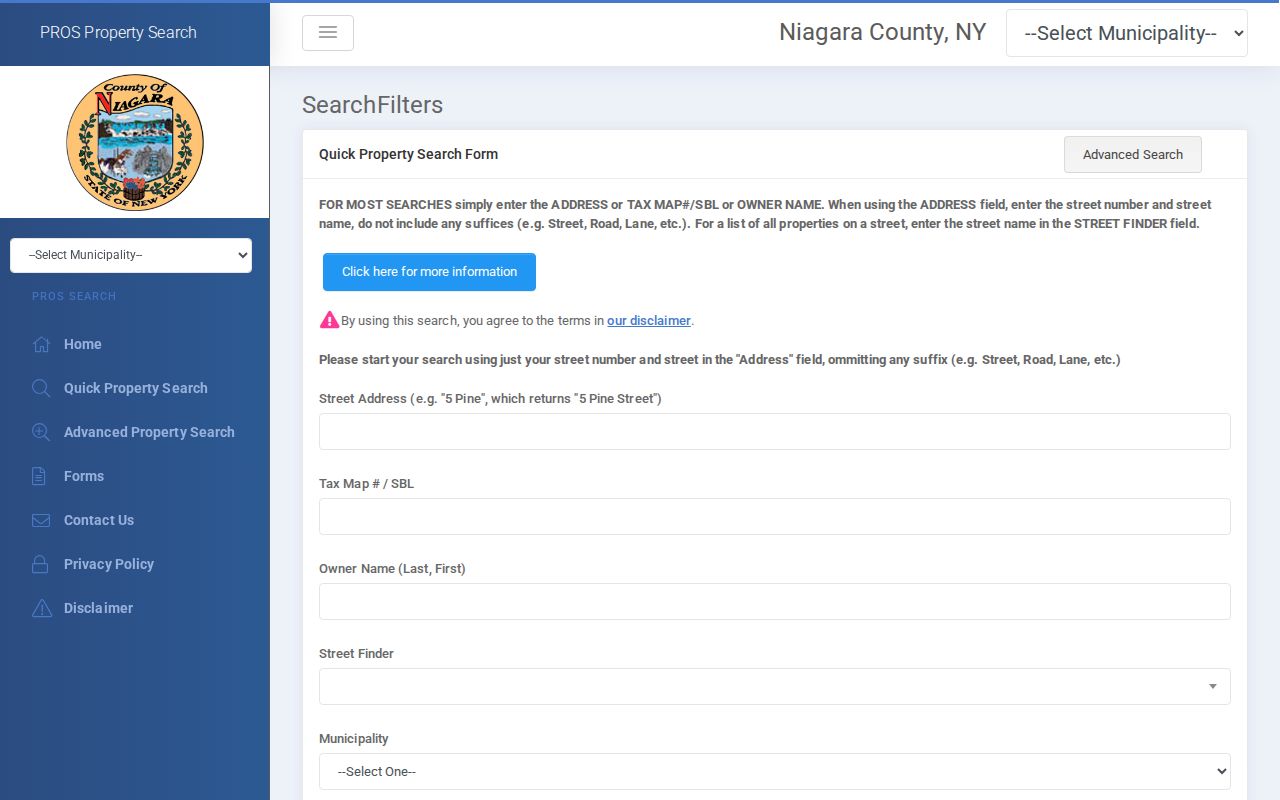
A PROS result is an assessment record. It can orient an address search, but it is not a certified deed, title opinion, or reliable statement of who occupies a property.
Read Niagara Falls Parcel Records
Parcel results often contain several addresses that mean different things. The situs is the physical property address. The mailing address is where tax correspondence goes, which may be a trust, relative, attorney, manager, or out-of-area contact. The legal description ties the interest to a lot, block, subdivision, or other land description. Carry the SBL into the GIS map and Clerk request rather than assuming the displayed mailing address establishes residency.
- Parcel or SBL
- A county tax-map identifier used to connect assessment, map, and land-record research.
- Situs address
- The address assigned to the physical parcel.
- Index
- A finding tool that points to a record; it is not necessarily the record image itself.
- Criss-cross directory
- An address-to-occupant directory arrangement, useful for a dated historical lookup.
Niagara County’s GIS viewer can search by owner, address, or SBL and offers map tools such as Select, Measure, Layer, Draw, and Bookmark. The Public Notification Tool can make a buffered parcel-owner mailing list and export CSV or PDF for public notice. That function is an ownership-navigation tool, not a current resident list.
Current Niagara Falls Directory Sources
Current sources cover different populations. A property record can show ownership and a tax contact, not every household member. A voter confirmation result requires matching inputs and does not permit browsing every voter on a street. Court indexes name parties rather than residents, and they omit sealed or otherwise restricted material. The comparison below makes the limits visible before a search begins.
| Source | What it can show | Keeper | Access |
|---|---|---|---|
| PROS parcel record | Owner or tax contact, parcel, situs, mailing address, assessment details | Niagara County Real Property/local assessor | Public web search |
| GIS parcel map | Parcel shape, adjacent parcels, mapping context, SBL navigation | Niagara County | Public viewer |
| Voter registration lookup | Matching registration and poll-site information | New York State Board of Elections | Individual identity-and-address lookup |
| Recorded land index | Parties to deeds, liens, mortgages, and maps | Niagara County Clerk | SearchIQS gate, request, or counter |
| City Court/eCourts | Case parties in available court scope | Niagara Falls City Court and New York courts | Online scope plus clerk access |
A search centered on one name needs a different sequence of records; use the Niagara Falls resident lookup route when the goal is confirming a person rather than following a street.
Niagara Falls Voter Confirmation
New York’s “Poll Site Search, Voter Registration, and Mail Ballot Tracker” is intentionally narrow. It asks for county, last name, first name, date of birth, and ZIP or address information. It is useful when those facts match a registered voter. It is not a public voter-roll browser and cannot support a claim that every registered voter on a named street is visible online.
The statewide voter file follows a different route. A request to the Board of Elections under Election Law §3-103(5) must state an elections purpose. Protected-address details, Social Security data, DMV identifiers, and full dates of birth are not general public display fields. For a missing or protected result, the proper response is to respect the access limit.
The New York voter lookup displays the individual search controls.
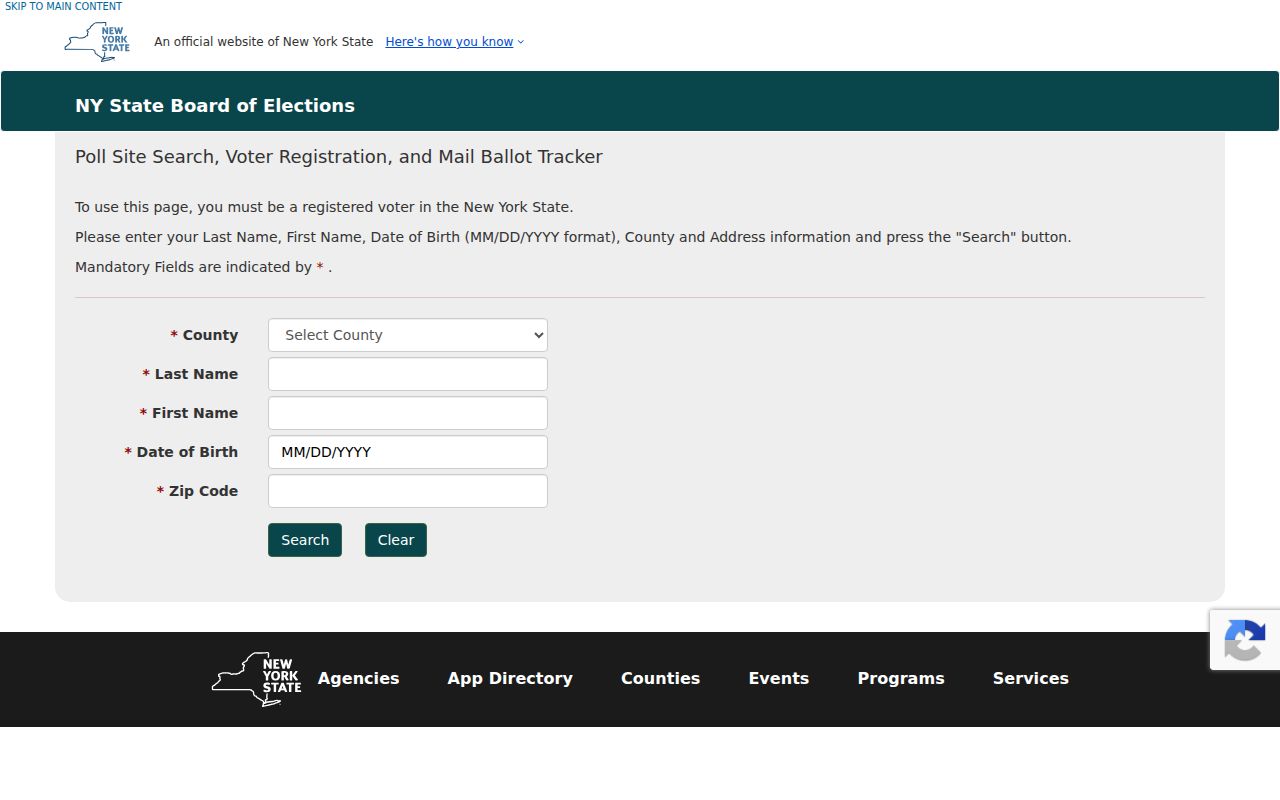
The image reflects the confirmation route, not a street-wide directory of people.
Niagara Falls Court Name Records
Niagara Falls City Court handles local civil, traffic, and criminal matters, with clerk access for certified papers and older files. New York eCourts then divides name searching by court scope. WebCivil Local covers local civil courts, WebCivil Supreme searches Supreme Court matters across the state, WebCriminal has selected pending and future-appearance information, and WebFamily is limited to active family matters. A party result is not a residence confirmation or a complete history.
WebCivil Supreme Party Search permits an index number, party, attorney, or justice search, with options for role, court, filing year, status, future appearances, and HTML or PDF output.
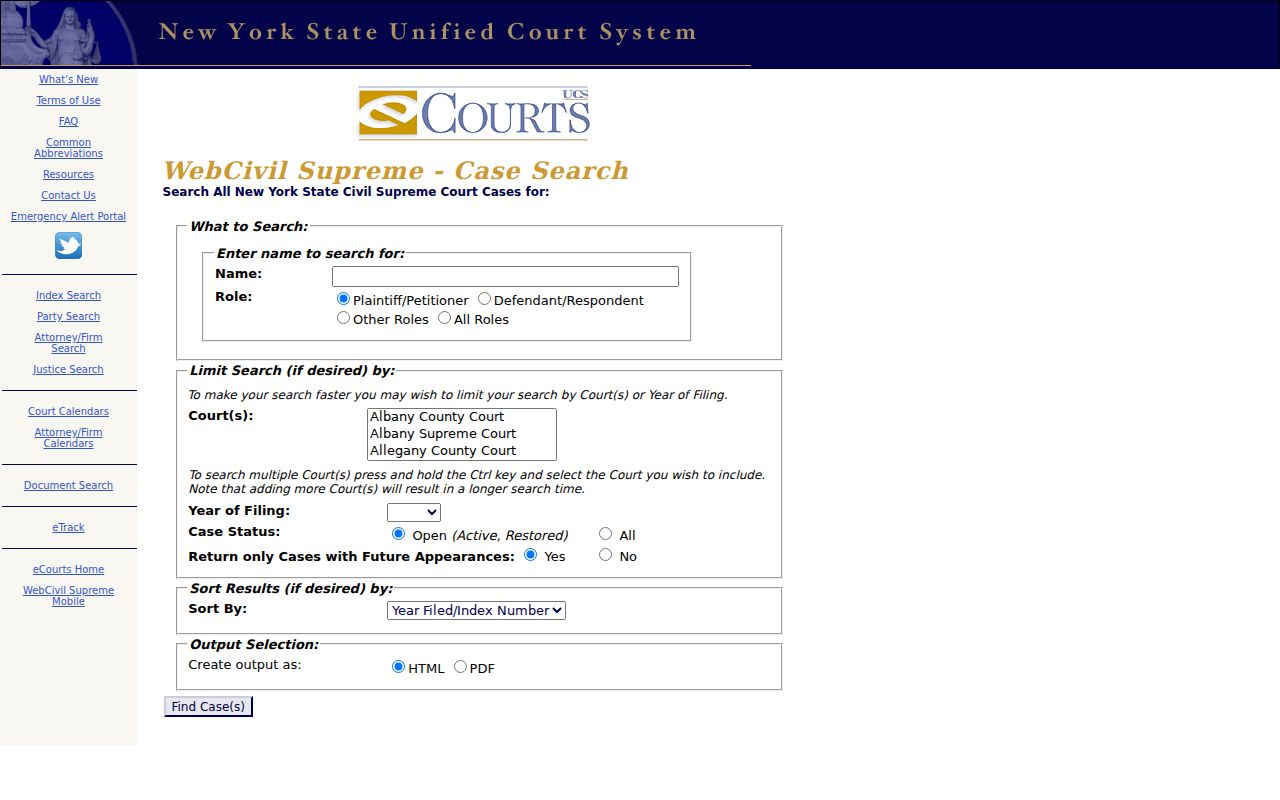
Sealed matters, youthful-offender material, juvenile and adoption records, and other statutory exclusions do not appear in ordinary web results.
Niagara Falls Deed Trail Limits
The County Clerk records deeds, mortgages, liens, maps, and related instruments. A land trail often starts with the PROS owner and SBL, then uses the purchase deed to identify the seller and legal description. The seller becomes the next grantee search in the earlier period. That repetition can build a transfer chain, but recording is ministerial, and neither a recorded deed nor assessment card independently decides title or occupancy.
SearchIQS is the Clerk’s online land-record route, but the official sources inspected show a login and subscription path rather than a published cutoff year, full public field list, or clear free-image policy. Do not promise an online year range. For an older book or map, the Clerk’s request instructions call for party names, recording date, and Book/Page or instrument number; the listed request route includes email, fax, in-person searching, and a stated response target of up to three business days.
The Niagara County SearchIQS login is the county’s indicated online gateway.
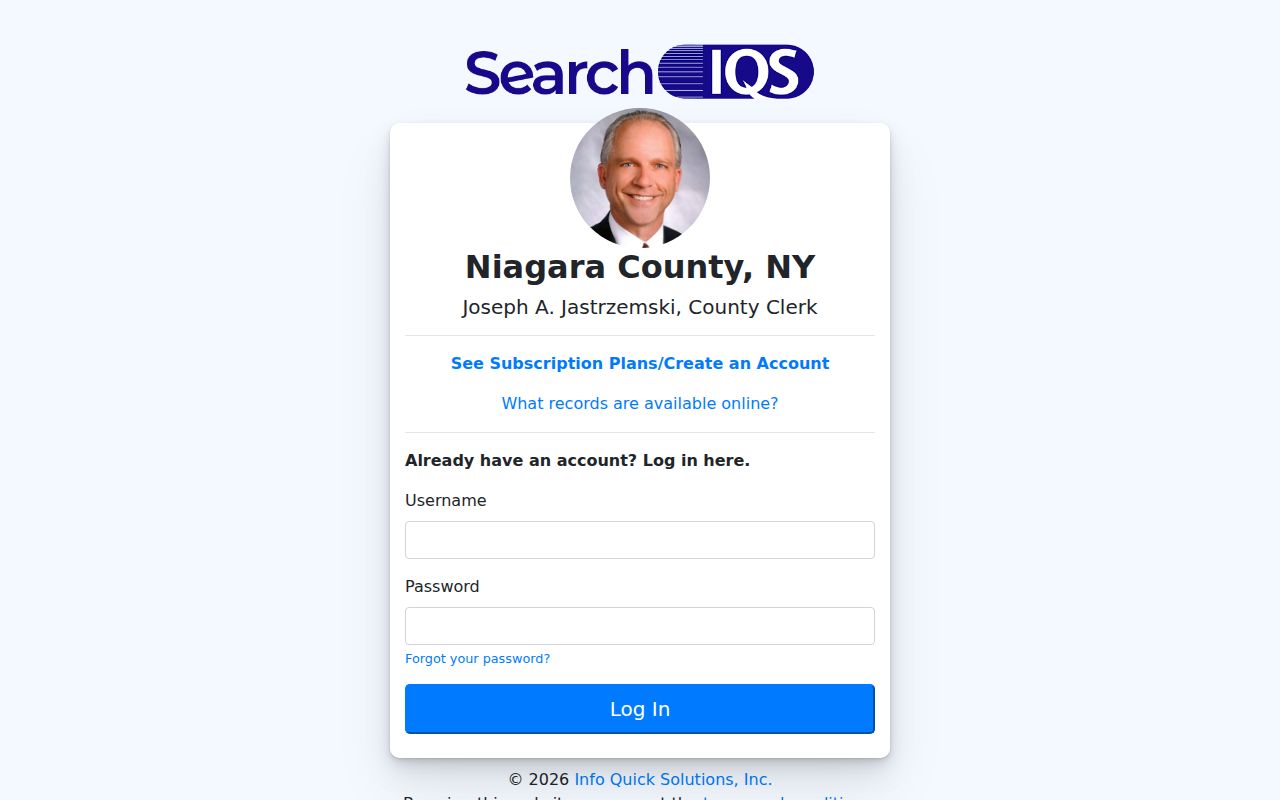
The visible login screen supports the cautious description of this route as an account or office-request path, not an openly documented all-years index.
Niagara Falls Records Requests
When a portal stops, a narrow request is more useful than an open-ended search for a person. Identify the custodian, record type, address or SBL, and a date range. A request for non-exempt parcel records between defined years gives the office a workable target. The County Clerk has a document and map request channel; city materials and permit questions should go to the appropriate Niagara Falls department or records custodian.
New York Freedom of Information Law, Public Officers Law Article 6, §§84-90, is the state fallback for non-exempt agency records. State guidance says an agency should grant, deny, or acknowledge a request within five business days; an acknowledgment normally supplies an approximate date no more than 20 additional business days away. Copies are generally capped at 25 cents per page up to 9 by 14 inches, while the actual cost of electronic reproduction may apply. The New York FOIL guidance explains the process and appeal framework.
Historical Niagara Falls Directories
Historical city directories give a dated association between a person and an address, business, occupation, cross street, or civic office. The Niagara Falls Public Library’s digitized collection contains 30 directory records from 1886 through 1923. Its cataloged physical Vernon runs extend from 1904-05 into 2008/09 with gaps and grouped volumes. A historical match needs the volume year, spelling, abbreviations, and nearby cross street preserved before comparing it with a modern address.
Older entries use compact labels such as h for residence, bds for boards or lodges, cor for corner, and n for north. Those marks are search clues, not errors. The specialized Niagara Falls directory book route has the fuller collection history and ways to read a reverse listing.
Niagara Falls Vital History Windows
For a city event, the local registrar or City Clerk can be a starting point, while the New York Department of Health is the statewide certificate and genealogy route. State Archives holds historical indexes and finding aids, not ordinary certified certificates. New York limits genealogy access by record type: birth indexes open after 75 years; death and marriage indexes open after 50 years, with further eligibility rules for certificate copies. A historical index entry can aid family research, but it is not a current-address record.
The New York vital-record genealogy route explains the state’s historical request path.
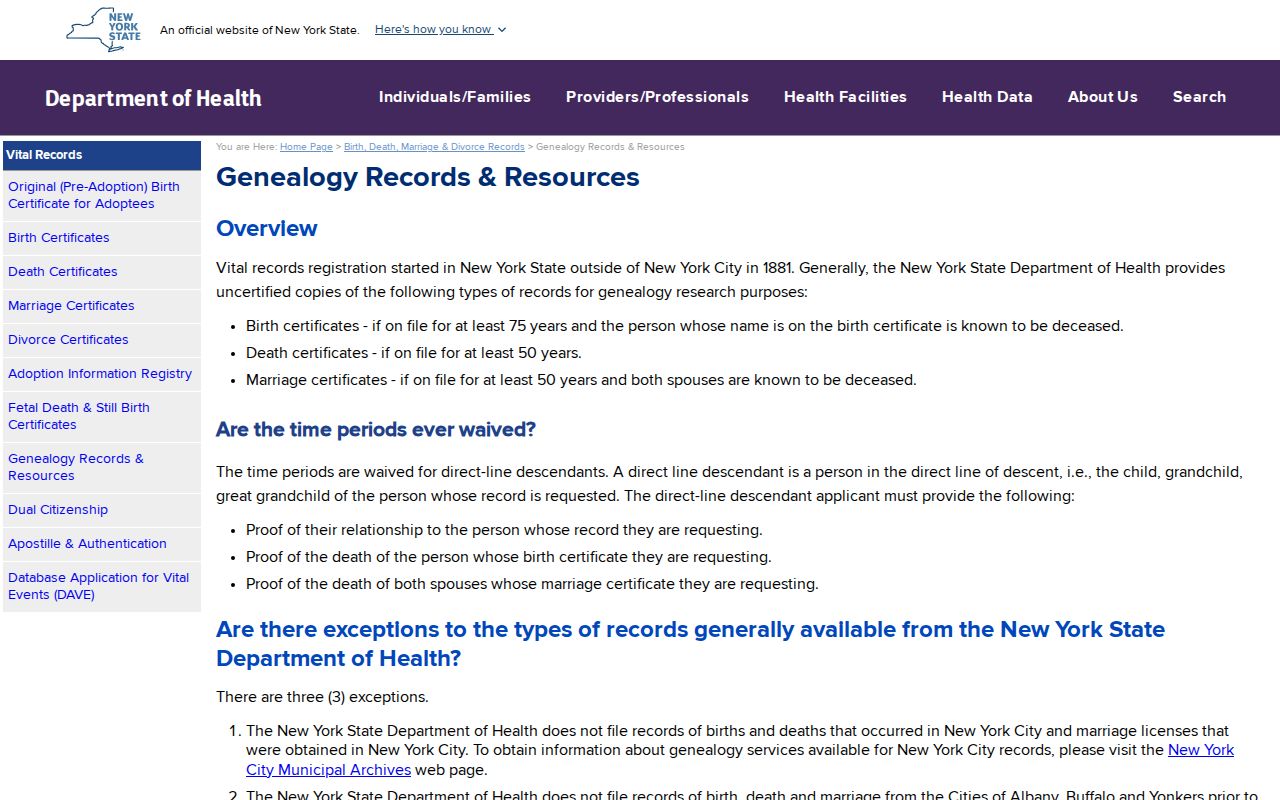
Use the time window and eligibility rules before submitting a certificate request, especially where a direct-line relationship or proof requirement applies.
Niagara Falls Family Record Trails
Family-history and heir research benefit from a dated trail rather than a single current-looking result. Start with the parcel SBL and recorded transfer history when an address is known. Pair that trail with an obituary, probate or Surrogate filing where publicly available, then compare an older Niagara Falls directory entry with the appropriate census or vital-index period. A historical address can connect a household across a year, but it should not be presented as a present residence.
New York’s State Archives maintains name indexes and historical pathfinders, while the Department of Health controls ordinary certificate access. For a birth-parent question, use New York’s adoption-registry and confidential-intermediary channels instead of a public search. For an estate question, request the relevant public probate or Clerk record and preserve the document date, parcel description, and party role. That is more reliable than treating a same-name match as a family relationship.
Niagara Falls Source Comparison
Official sources show what a named custodian keeps and the limits on that record. Commercial people-search products are compiled leads that can combine public records, marketing data, address history, licensed data, and inferred relationships. A compiled match may be stale, costly, or hard to correct. Treat it as a prompt to verify the underlying record, never as the final answer.
| Source type | Best use | Important limit |
|---|---|---|
| County assessment and GIS | Parcel, owner, tax contact, and mapping orientation | Does not establish title or current occupancy. |
| County Clerk record | Recorded transfer parties and legal description | Access may be gated; recording does not determine title. |
| State voter tool | Matching individual registration confirmation | No street-wide browser; protected data remains restricted. |
| Compiled commercial directory | Possible research lead | Accuracy, recency, and correction practices vary. |
Niagara Falls Privacy Boundaries
Not every absent name is a missing record. New York’s Address Confidentiality Program can provide eligible participants with a substitute mailing address and protected voter procedures can limit public display. DMV personal information is restricted by the federal Driver’s Privacy Protection Act. Sealed court files, confidential vital records, and protected voter details are not gaps to work around.
Note: An address that does not appear in an open result may be protected by law and should be left protected.
Niagara Falls Records in Transition
Niagara County’s current property work moves through PROS, GIS, and the Clerk’s SearchIQS route, while older local context remains in directories, maps, library collections, and archives. The county’s exact online deed-index cutoff has not been published in the official material reviewed, so office access remains important. The local record trail is split by function, not lost in one system.
Niagara Falls Public Library has been moving parts of its local-history holdings toward digitization. Its 2023 board minutes record a $500,000 Ralph C. Wilson Foundation award, and 2024 minutes describe hotel-register material and several local collections sent for digitization. That work expands access over time, but it does not mean every collection is already online.
The Niagara County incarcerated-individual search is another official index with a narrower purpose. Its visible cards include booking details, but a booking is not a conviction and the source does not state historical coverage or a result cap.
Use each official system only for the question it can answer, and confirm a material fact with the custodian before relying on it.