
Niagara Falls Historical Directory Collections
The strongest historical shelf begins with the Niagara Falls Public Library collection in New York Heritage. It holds 30 public digitized city directories from 1886 through 1923. Those scans are useful when a surname, old address, hotel, rail office, or business name supplies a starting point. They are not a continuous annual run in every possible year, so the item list should be checked before reading too much into a gap.
| Collection | Years | Where Held | Access |
|---|---|---|---|
| Digitized Niagara Falls City Directories | 1886-1923, 30 volumes | NY Heritage and NFPL ContentDM | Public scans with item-page and PDF/image access |
| Vernon's Niagara Falls directories | 1904-05 to 2008-09, cataloged runs with gaps | NFPL Local History and Reference | Physical local-history/reference volumes |
| NCGS directory service | 1901; 1932-1991 listed | Niagara County Genealogical Society | Paid targeted or five-year lookup service |
| Sanborn maps | 1888, 1892, 1897, 1914/1955 and later listed issues | Library of Congress | Public scans for building and street context |
The later physical run matters. NFPL's catalog lists grouped Vernon holdings from 1904-05, 1908-09, 1909-10, 1911-16, 1919-26, and later decades, with annual or near-annual volumes through 2006-07 and 2008-09. The NCGS listing is a service sample, not a substitute for the library catalog. Use the catalog as the holding record and ask about a particular volume before making a trip.
Thirty Niagara Falls Directory Volumes
The digitized set begins with 1886-87 and includes 1890-91, 1892, 1896, 1898, 1899, then annual entries from 1900 through 1923. The collection captures a city of hotels, rail connections, civic offices, shops, and homes. That mix makes a city directory useful for tracing both a person and the setting around an address.
The digitized Niagara Falls directories collection shows the online shelf and its dated items.
Use the collection view to choose a year first, then preserve the printed page number and item link with each useful entry. That keeps a later family-history check tied to the original volume rather than to a copied name alone.
Decode a Niagara Falls City Directory Entry
The 1886-87 directory is a good reminder that small marks carry meaning. Its printed page 25 includes residences, business affiliations, civic positions, hotels, and cross-street directions. One entry may give a person, an occupation, an office address, and a home notation. Another may describe a business rather than a household. Read the page heading and the volume's abbreviation key before extracting a name.
| Name | Alphabetical name, often with an honorific, initial, widow marker, or business partnership. |
|---|---|
| Occupation or office | Work, civic role, or business affiliation shown in that edition. |
| Residence | h means house or residence; the address may use a cross-street direction. |
| Boarding | bds signals boards or lodges at an address, not ownership. |
| Street language | cor means corner and n means north in the inspected sample. |
- Criss-cross directory
- An address-ordered section that can point from a street address to a listed occupant or business.
- Householder index
- A name list focused on householders, which may omit other people at the address.
- Abbreviation key
- The volume's printed guide to its compact terms. Photograph or note it before interpreting entries.
Not every volume has a separate reverse or criss-cross section. If the task begins with an address, inspect the front matter and contents before assuming the answer is indexed by street.
Niagara Falls Local History Desk
NFPL Local History is more than a book shelf. Its catalog covers names, subjects, record groups, books, documents, audiovisual material, objects, maps, photographs, newspapers, and clipping files. The department asks for two business days' notice to pull many requested materials. That lead time is important for a research visit, especially when the directory entry needs to be checked against a map, clipping file, or finding aid.
The NFPL Local History catalog is the first stop for locating an item, subject heading, or record group before contacting the department.
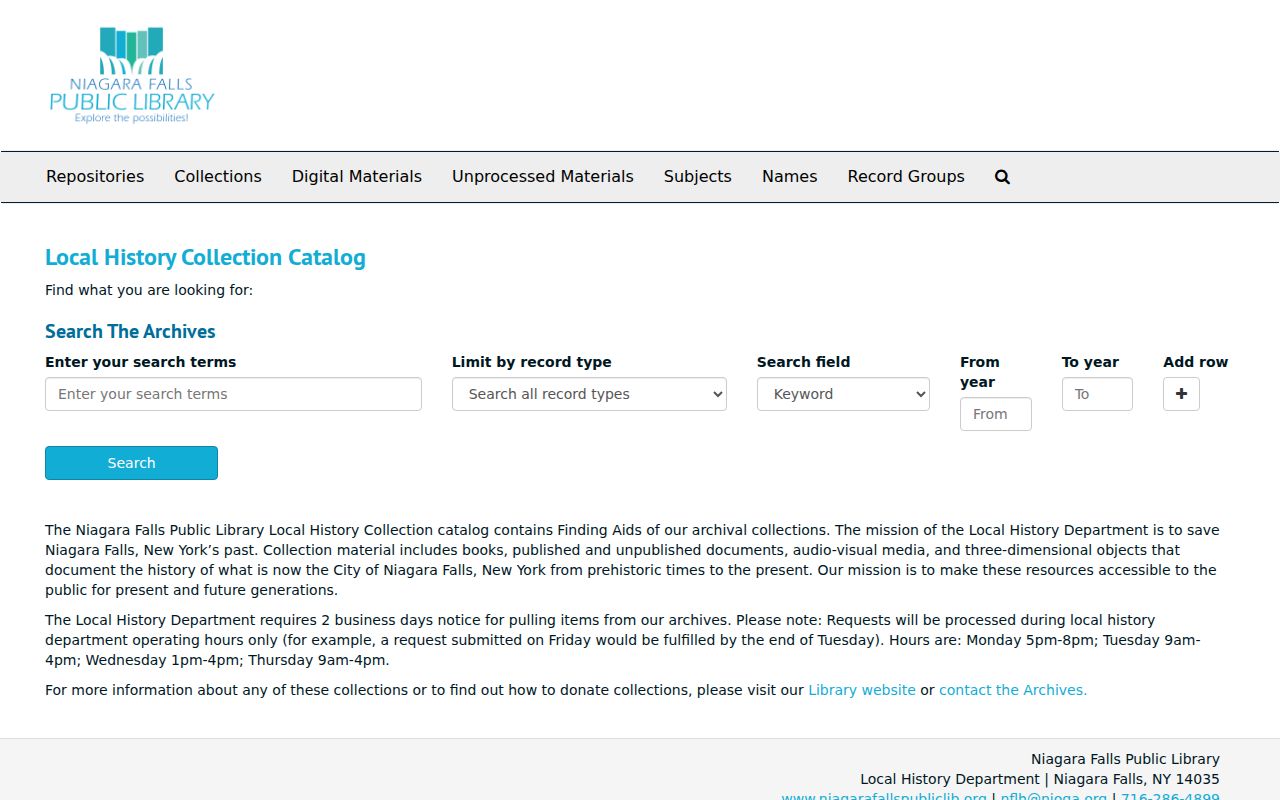
A catalog hit identifies material to request, but it does not guarantee that a directory page or archival collection has been digitized. Give staff the name, year, address, and any cross street already found.
Niagara Falls Names Beyond Directories
Historic Niagara complements the city-directory volumes with references to names, places, events, books, journals, clipping files, scrapbooks, audiovisual material, correspondence, and microforms. It also points researchers toward cemetery, census, vital, and church indexes when a directory entry is too brief. The Niagara County Historical Society, also known as Niagara History Center, offers collections and research assistance in Lockport, though its exact name-index coverage and fee list should be confirmed before requesting work.
For a later directory gap, the Niagara County Genealogical Society offers a 30-minute lookup or obituary service. Its published form lists a first member lookup as free, an obituary lookup at $6, and a 30-minute lookup at $10. Give the most precise death date and city or town of death available for an obituary request.
Trace Niagara Falls City Directory Families
A directory trail works best as a sequence, not as a single search. Begin with the earliest reliable name or address, then move in both directions through the volumes. Census records add household composition at their released dates, while directories fill many of the years between them. Federal census records are public under the 72-year release rule, so they cannot complete a recent household trail.
- Find the person or address in one dated volume and copy the spelling exactly.
- Record residence, occupation, spouse or widow notation, cross street, and page number.
- Check the nearest prior and later directory years for a move, changed initial, or changed affiliation.
- Pair the address sequence with released census years and an obituary, cemetery, or probate route when appropriate.
- Use a Sanborn issue to compare the building and street context, not to identify a present occupant.
A missing listing can mean a move, death, unlisted household status, a changed spelling, or simply a gap in the run. It should never be treated as proof that the person was absent from Niagara Falls.
Niagara Falls Directory Timeline
The local record trail changes format over time. A concise timeline helps select the right shelf without implying a single continuous archive.
- 1886-87: earliest verified digitized Niagara Falls directory in the NFPL collection.
- 1886-1923: 30 digitized directory records available through NY Heritage.
- 1904-05 to 2008-09: NFPL cataloged Vernon runs extend later, with gaps and grouped volumes.
- 2023: NFPL recorded a $500,000 local-history digitization award.
- 2024: hotel-register and named local collections were sent for digitization, without a promise that every item is online.
Those digitization efforts are especially useful for relatives tracing a former address, school, organization, or local event. Catalog availability still controls whether a particular item can be viewed online.
Niagara Falls Addresses on Maps
Older entries often rely on Main Street, Niagara Street, Pine Avenue, Hyde Park Boulevard, and nearby cross streets rather than modern delivery details. Pair the directory with Library of Congress Sanborn maps from 1888, 1892, 1897, and 1914/1955 issues. Maps show building footprints, use, material, and street context. They do not prove who lived there.
Street numbers can change, a printed address can be abbreviated, and a business can occupy only part of a building. Compare the map issue closest to the directory year before linking two similar locations.
When the question shifts from a historical listing to a current parcel, use the modern Niagara Falls street directory workflow rather than extending an old directory entry into the present.